
PNP Canada Permanent Residence Application Help You Can Rely On
· Editorial Team

Last Updated: November 7, 2026
Quick Summary
PNP Canada permanent residence application help turns a provincial nomination into a complete federal permanent residence application submitted to IRCC, which makes the final decision. The province selects you, but the federal government assesses forms, supporting documents and fees separately, so a valid nomination alone does not guarantee approval.
- An enhanced nomination adds 600 points under the Comprehensive Ranking System for Express Entry nominees.
- An Express Entry profile is valid for 12 months, so check expiry before accepting a nomination.
- Police certificates are the item most likely to hold up a file, so start them first.
- A request for additional documents is a deadline, not a refusal; missing it can close the file.
- No one can guarantee processing times because IRCC controls them.
Table of Contents
- What PNP Canada Permanent Residence Help Actually Covers
- PNP Express Entry Application Process: The Faster Route
- PNP Non-Express Entry Application Process: The Paper-Based Route
- Your Provincial Nominee PR Document Checklist by Applicant Type
- PNP Application Processing Delays and How to Handle Them
- Common Application Errors That Cause Returns and Refusals
- When Circumstances Change After Nomination or Submission
- How to Assess Paid PNP Canada Application Help Before You Commit
- Frequently Asked Questions
What PNP Canada Permanent Residence Help Actually Covers
PNP Canada permanent residence application help turns a provincial nomination into a complete, correct federal permanent residence application. At ONETERRA, we have spent over 15 years working on permanent residence files, and the work is more procedural than most people expect.
A nominee can hold a valid nomination and still lose months to a returned package, a missing police certificate, or a fee paid against the wrong stream.
That split causes most confusion. Provincial and federal requirements are separate tests, assessed by separate bodies on separate timelines. Passing one does not guarantee the other.
| Stage | Who decides | What it produces |
|---|---|---|
| Nomination | Province or territory | Nomination certificate |
| Federal PR application | IRCC | Permanent resident status |
| Medical and security checks | IRCC and panel physicians | Admissibility clearance |
PNP Express Entry Application Process: The Faster Route
The PNP Express Entry application process is the quicker path for nominees who hold an enhanced nomination linked to an Express Entry profile. An enhanced nomination gives the applicant 600 additional points under the Comprehensive Ranking System (Provincial Nominee Program : Express Entry process Get or confirm a nomination).
- Create an Express Entry profile and enter the pool.
- Receive a provincial nomination tied to that profile.
- Accept the nomination in your online account so the 600 additional points attach.
- Wait for an invitation to apply from IRCC.
- Submit the complete permanent residence application through the online portal.
- Complete biometrics, the medical examination and police certificates as instructed.
Speed is the appeal. An enhanced nomination depends on an active Express Entry profile meeting the stream's criteria. If your profile expires or your circumstances change, the nomination can lose its effect.
How to Confirm You Actually Have an Enhanced Nomination
Not every nomination that arrives alongside an Express Entry profile is enhanced. A base nomination cannot attach the 600 additional points, and applying on the wrong assumption wastes months. Check these before you accept anything:
- Check the nomination certificate. An enhanced nomination is issued through Express Entry and references your profile number and job seeker validation code. A base nomination carries no such references.
- Confirm the stream. Provinces run both enhanced and base streams, sometimes under similar names. The stream name on the certificate tells you which you hold.
- Verify the points posted. After accepting, log back in and confirm the 600 points appear in your CRS score. If they do not appear within a few days, do not assume they will.
Watch out: accepting a nomination without confirming the 600 points have posted is a common slip that can cost you a draw. Points do not always attach automatically.
What Happens If Your Profile Changes After Nomination
An enhanced nomination is tied to the profile that existed when the province issued it. If your circumstances change materially, a new passport, a change in family composition, a correction to your work history, your profile and nomination must stay consistent.
Update your profile before you receive an invitation to apply where possible. Once an invitation is issued, IRCC assesses the information as it stood at that time, and post-invitation changes go through a different process that can add time.
When the Enhanced Route Is Not the Right Fit
The enhanced route rewards applicants whose profile already competes in the pool. If your language scores, education assessment or work history would not be competitive even with 600 additional points, confirm with the province whether a base stream nomination is possible instead, switching after the fact is not always possible.
PNP Non-Express Entry Application Process: The Paper-Based Route
The PNP non-Express Entry application process suits nominees who do not qualify for Express Entry or whose stream uses a base nomination. A base nomination does not carry the 600 additional points.
The mechanics differ in small but important ways. You apply directly to IRCC rather than waiting for a draw, your nomination certificate must still be valid at submission, the document set is broader, and the review is more manual.
The right choice depends on your profile, stream and provincial requirements.
Your Provincial Nominee PR Document Checklist by Applicant Type
A provincial nominee PR document checklist should be built around the applicant rather than a generic template. The principal applicant, accompanying family members and dependants each generate their own paperwork, and missing one item from one person returns the whole package.
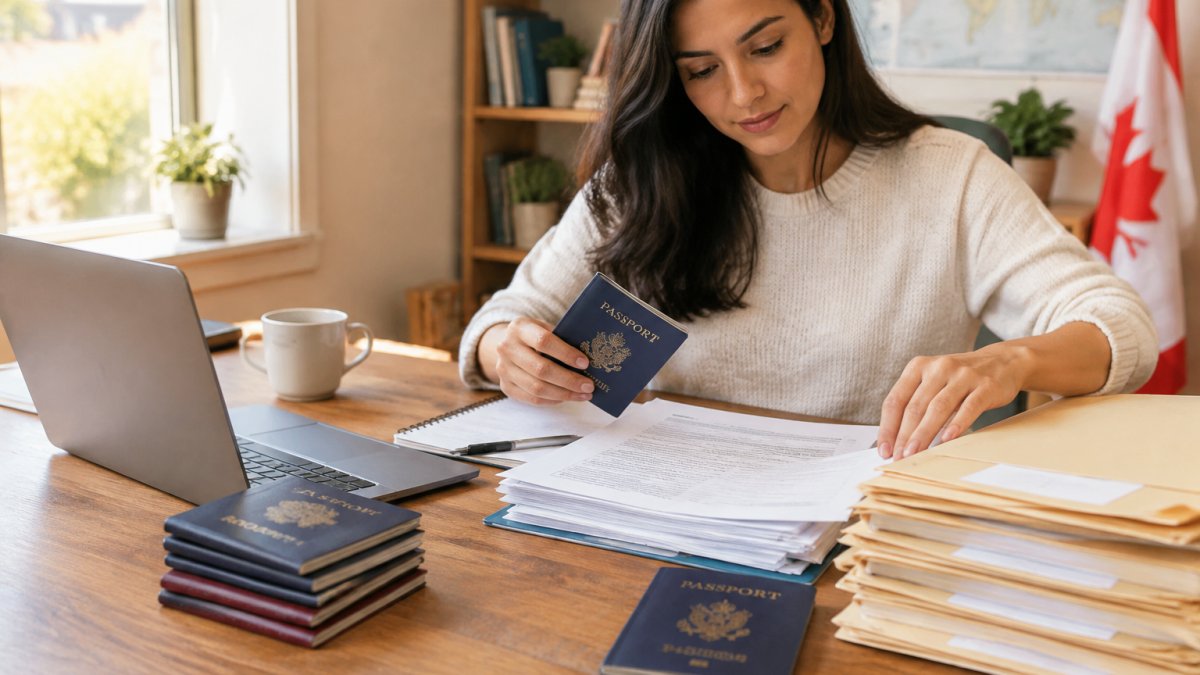
Core Documents for the Principal Applicant
Start with the set every file needs, then verify each item against the specific stream requirements on the nomination certificate:
- Proof of nomination, valid on the submission date
- Passport or travel document covering the full application period
- Completed application forms, signed and dated with the current form version
Documents for Accompanying Spouses or Partners
A spouse or partner is a separate applicant on the file, not an attachment to the principal applicant. Each accompanying adult needs:
- Passport or travel document
- Birth certificate
- Police certificates for every country of residence over the required period
Documents for Dependent Children
Dependent children generate their own document set, and the requirements change with age and custody arrangements:
- Passport or travel document for each child
- Birth certificate showing both parents
- Medical examination results from an approved panel physician
Country-Specific Police Certificate Rules
Police certificates are the item most likely to hold up a file, and the rules vary by country in ways a generic checklist does not capture:
- Country of residence. Police certificate requirements depend on the countries where the applicant has lived since turning 18; confirm the current requirement on the official IRCC website.
- Federal versus state or local certificates. Some countries issue only national-level certificates; others require state, provincial or municipal ones. Submitting the wrong level is a common return reason.
- Fingerprint-based certificates. Some countries issue certificates only after fingerprinting, with processing running weeks to months. Start these first.
Translation, Certified Copies and Formatting
Documents not in English or French must be accompanied by a complete translation, plus an affidavit from the translator or a certified copy of the original, depending on the document type (What language should my supporting documents be in?). Photocopies are acceptable for most documents, but IRCC can request originals at any stage, so keep them accessible. Forms must be the current version on the IRCC website at submission; an outdated form is a return reason on its own.
How to Sequence the Checklist
Files with dependants can take longer to assemble, so it is sensible to start police certificates early, since they are often the slowest item to obtain. Book medical examinations only after confirming which panel physician serves your area and how long results take to reach IRCC. Language tests, where required, must be valid on the submission date, not just the date you received them.
PNP Application Processing Delays and How to Handle Them
PNP application processing delays are normal, and most are not caused by IRCC losing the file. The usual culprits are an incomplete package, a slow police certificate, a medical that needs follow-up, or a request for additional documents the applicant did not see in time.
Here is how we would handle a delay:
- Check application status in the portal before assuming anything is wrong.
- Confirm no request for additional documents is sitting unanswered.
- Verify your contact details and email are current.
A request for additional documents is not a refusal. It is a deadline. Miss it and the file can be closed. If your circumstances have changed, tell IRCC rather than waiting to be asked.
Common Application Errors That Cause Returns and Refusals
Most returns trace back to a short list of avoidable mistakes.
The most common is a mismatch between the nomination and the federal forms. A changed address, a new passport or a corrected date of birth must appear consistently everywhere.
Watch out: submitting the application before the nomination certificate is actually in hand, or before biometrics instructions arrive, creates a file that cannot be processed and may be returned.
When Circumstances Change After Nomination or Submission
A marriage, a birth, a divorce, a job loss, a move to another province or a new passport all affect an open file.
Changing provinces after nomination is the delicate one. A nomination is issued for a specific province or territory, and the federal application is assessed against it.
If you work with an authorized representative, tell them first. They can advise on what to disclose, how, and which forms need re-signing.
How to Assess Paid PNP Canada Application Help Before You Commit
Paid help can be useful when the file is complex or the timeline is tight.
Ask these questions in writing:
- Who is licensed or authorized to represent you, and under which body?
- What exactly is included, and what is billed separately?
- How and how often will they communicate with you?
Two things matter: whether the representative is authorized to deal with IRCC on your behalf, and whether the firm can explain the route-selection logic for your case. No one can guarantee processing times, because IRCC controls them.
ONETERRA has experience supporting Fortune 100 and 500 corporations on large inbound labour projects.
If you are weighing a switch from another firm, ask about handoff risk directly, and ask any firm to describe how a transfer would be documented.
The hardest part of a PNP file is rarely the nomination. It is the months of document assembly, deadline management and status checking that follow.
Frequently Asked Questions
How do I apply for permanent residence after receiving a provincial nomination?
The route depends on the nomination type. An enhanced nomination tied to Express Entry gives you 600 additional Comprehensive Ranking System points and an invitation to apply through your online account, where you submit the permanent residence application within the deadline IRCC sets. A base nomination runs outside Express Entry: you submit a paper or online permanent residence application to IRCC with proof of nomination, supporting documents and the application fees. In both cases, the nomination must stay valid until a decision is made, so check expiry dates before you file.
What documents do I need for a provincial nominee PR document checklist?
A typical provincial nominee PR document checklist covers your passport and travel history, proof of nomination, language test results, educational credential assessments, employment letters and pay records, police certificates for the countries you have lived in since turning 18, as required by IRCC, and upfront medical examination results. Dependants need passports, birth certificates and, where relevant, custody or adoption papers. Applicants inside Canada add status documents; applicants outside add civil documents with certified translations. Requirements vary by stream, so confirm the exact list for your program before submitting.
What is the difference between Express Entry and non-Express Entry PNP applications?
The PNP Express Entry application process is handled through the online Express Entry system, and an enhanced nomination adds 600 points to the applicant's profile. The PNP non-Express Entry application process is separate from the Express Entry pool, uses the provincial nomination as the basis for the federal application, and Neither route guarantees a processing time, and IRCC publishes current figures. Your nomination letter states which category applies, so check it before choosing a route.
What should I do if my PNP permanent residence application is delayed?
Start with your online application status and note whether IRCC has requested additional documents, because an unanswered request is the most common cause of PNP application processing delays. Respond to any request within the stated deadline, keep your contact details current, and order GCMS notes if the file has sat idle well past the published processing time. If your nomination is close to expiry, ask the province about an extension. A representative can help you review your file for missing items, but no one can control the timing of IRCC's decision.
Can I get help correcting an error in my permanent residence application?
Yes. Minor errors such as a misspelled name or a wrong date of birth can often be corrected by sending a case-specific inquiry or web form with the correct information and supporting proof. Larger errors, such as an undeclared family member or a missing document, need to be fixed before IRCC assesses the file, because misrepresentation findings carry serious consequences. Acting early is generally sensible, since corrections are raised before a decision is made.

